SBIR/STTR
The SBIR Technical Risk Section: Why "No Risks" Reads as Engineering, Not R&D
Most founders draft their SBIR Specific Aims to sound as confident as possible, and that instinct is backwards: one external reviewer on a Cada-drafted NASA proposal wrote that risk-free writing "reads more as engineering than R&D." This guide gives founders a three-part credibility test for technical risk statements, a six-failure-mode table, and five worked cross-agency examples (NIH, NASA, NSF, ARPA-E, AFWERX) showing exactly what a scored risk section looks like.
How to Write an SBIR Significance Section: The Six-Sentence Opener (And the One Step Founders Skip)
The opening paragraph of your Significance section is the highest-stakes paragraph in an SBIR proposal, and most first-time founders get it wrong by leading with their technology. This guide lays it out as a fixed six-sentence sequence, distilled from external-reviewer track-changes, and names the one step founders skip almost every time: naming the current standard of care before pitching the solution.
A Federal Grant Application Has About 100 Fields. Only 25 of Them Are Actually Yours.
A federal grant application touches about 100 discrete fields, but only roughly a quarter of them are actually the founder's job to answer. This piece publishes Cada's field-bucket classifier (founder-facing, portal-only, consultant-prefilled, consultant-internal) and the 0-100 readiness score that gates drafting, so you can self-score before you ever open an intake form.
Can ChatGPT Find SBIR Grant Opportunities? We Tested It -- Web Search Missed All 115 Open Topics
Founders using ChatGPT or Google to find SBIR opportunities are working from a lagging index, not a live government record. In a direct comparison, web search missed every one of 115 open DoD SBIR topics that the DSIP API correctly listed as open. This piece explains the mechanism, the always-open BAA trap that wastes 40+ hours, and the exact verification checklist Cada runs before recommending any opportunity.
How to Choose the Best SBIR Consultant: The Criteria That Matter (and When Not to Hire One)
Most "best SBIR consultants" lists are published by a consultant ranking themselves first. This guide gives founders the five verifiable criteria to evaluate any SBIR consultant, a five-question script for the first call, and the real cases where hiring one is not the right move.
SBIR Budget Percentages: Direct Labor, Indirect, and the Ratios Reviewers Flag
Reviewers pattern-match your budget ratios before they read a sentence of narrative. This piece publishes the reasonableness bands Cada uses to screen budgets before submission -- direct labor, equipment, subcontracts, indirect -- plus the hard caps at NIH, NSF, AFWERX, and ARPA-H and the five red flags that reliably trigger scrutiny.
Can a Visa Holder Be the PI on an SBIR Grant? The Agency-by-Agency Rules for Immigrant Founders
Can a visa holder be PI on an SBIR grant? Yes, at every major agency: none of the six SBIR agencies require the PI to be a US citizen or permanent resident. The binding constraint is whether your visa lets you work more than half-time for your own startup. This guide gives the sourced agency-by-agency rules plus the H-1B, O-1, and F-1 OPT mechanics nobody publishes.
Is My Idea Innovative Enough for SBIR? The Pre-Draft Novelty Test for NIH, NSF, ARPA-H, and AFWERX
Every first-time applicant asks whether their idea is innovative enough for SBIR. It is the wrong question, because there is no single SBIR innovation bar: NIH scores scientific novelty, NSF requires unproven technical risk, ARPA-H requires a 10x non-incremental claim, and AFWERX accepts mature-technology integration that closes a named capability gap. This guide publishes the four pre-draft novelty tests Cada runs before writing anything, plus the routing table that tells you which agency's bar your idea actually clears.
NSF SBIR for AI Startups: The Single-Axis Pattern Behind Real Declines
NSF's public guidance says it funds high-risk innovation. Its decline letters are more specific: the hard declines cite the same single criterion in nearly identical language, and AI-application pitches are the most consistent casualties. This piece publishes the pattern, the language NSF uses, and the 3-question screen to run before you spend a cycle.
How to Read Congressional Budget Justifications for Grant Strategy: The Most Underused Public Document in Grant Writing
Every federal agency tells Congress, program office by program office, which budgets it plans to grow and which it plans to cut -- months before any solicitation changes. Almost no founder reads these documents. This guide covers the 3 sections of a congressional budget justification that matter, a 45-minute reading process per agency, and the current FY2027 signals for the 6 agencies that fund most startup R&D.
DOE Office of Science SBIR Priorities: How to Read Them Before You Pick a Topic
DOE is two different funders wearing one name. ARPA-E rewards disruption; the Office of Science rewards alignment with published research priorities. This guide shows the actual priority terms Cada extracted from BES, ASCR, and BER strategic documents, so you can check fit before you spend an hour drafting.
What Counts as Preliminary Data for an SBIR When You Have No Publications: The Four Evidence Categories Reviewers Accept
About 1 in 5 companies Cada builds grant roadmaps for get flagged for having no peer-reviewed publications. Most treat it as disqualifying, and it usually is not. This guide gives you the four evidence categories reviewers actually accept, the three-part test that separates evidence from assertion, and the cheapest experiments that move you up a category.
SBIR Registration Requirements Timeline: Every Federal System You Need Before You Can Submit, In Order
Every guide covers one registration system. Nobody stacks them. This is the full SBIR registration requirements timeline in dependency order, with each agency's published lead time, a matrix of which systems each agency requires, and a worked backward count from a real deadline. It also names the three steps first-time applicants discover too late.
How Much Does a Grant Writer Cost for an SBIR? The Real Numbers, and When to Write It Yourself
Grant consulting firms almost never publish prices, so founders infer them from forum threads and sales calls. Here are the actual rate bands by pricing model, the reason you cannot pay the fee out of the award it wins, and the expected-value math that tells you whether hiring is worth it. It also names four cases where the honest answer is to write it yourself.
Federal Grants for AI Startups: Which Agencies Actually Fund Machine Learning
Every guide to federal grants for AI startups is organized agency-first, which only helps a founder who already knows which agency to read about. This one runs the other direction, starting from a scan of USAspending award records for FY2023 to FY2025. NIH turns out to be the largest single source of AI and machine learning small-business awards, ahead of NSF, and the National Institute on Aging leads NIH. It also shows where the award data lies to you.
How to Find a University Partner for STTR (When You Don't Know a Single Professor)
Every STTR guide assumes you already have a professor. This one starts where most founders actually are, knowing nobody, and treats partner sourcing as a searchable process: the real 40/30 split, how to build a candidate list from NIH RePORTER and NSF Award Search, the cold email that gets answered, and the 8 to 10 weeks the paperwork actually takes. It also works out what a $90,000 subaward really buys after the institution's F&A comes out.
AFWERX SBIR Eligibility Requirements: The 10-Gate Compliance Pre-Screen
The AFWERX SBIR eligibility requirements have almost nothing to do with your technology. Ten administrative gates -- ownership structure, PI employment, ITAR and FOCI posture, five registrations, and the subcontract and profit caps -- decide whether a reviewer ever opens your proposal. This is the Phase 0 pre-screen Cada runs before agreeing to draft for a defense client, with the numeric caps, the real lead times, and the rule that two or more flags means fix your posture before you write.
SBIR Ownership Requirements and PI Citizenship Rules: What Visa-Status Founders Actually Need to Fix
SBIR ownership requirements and PI citizenship rules are two separate tests, and visa-status founders constantly get told they fail both when they usually fail only one. This guide puts the ownership thresholds and PI rules for NIH, NSF, NASA, and DoD side by side, separates the curable eligibility problems from the genuinely disqualifying ones, and runs an O-1 founder with a majority-foreign cap table through both tests.
You Won Your First SBIR. Now What? The 90-Day SBIR Post-Award Checklist Nobody Hands You
You won your first SBIR, and a 90-day compliance window opens that nobody prepares you for. This checklist sequences every registration, kickoff step, accounting requirement, report, and IP deadline in the order it needs to happen, branched by whether you won a grant or a contract. Miss the wrong deadline in the first 90 days and your payments can freeze.
NSF SBIR Pitch Rejection Reasons: The Prior-Art Parity Test Most Declines Are Decided On
Most technically strong NSF SBIR pitches fail for one reason: published state of the art already meets or beats the pitch's Phase I target. This guide teaches the Prior-Art Parity Test, the four-step go/no-go check Cada runs before writing any NSF pitch. Run it yourself in 2 to 4 hours, before you spend 40+ hours on a pitch that was never competitive.
SBIR Grant vs Contract: How Your Award Instrument Changes Cash Flow, Audits, and IP
Most founders compare SBIR programs by dollar amount, but the award instrument -- grant or contract, fixed-price or cost-reimbursement -- matters more. It decides when you get paid, who audits your books, and how you protect your IP. This guide maps grant vs contract across the SBIR agencies and shows what actually changes when you cross from an NIH grant to a DoD contract.
State SBIR Matching Funds: The State-by-State Database of Non-Dilutive Money That Stacks on Your Federal Award
34 states pay cash on top of a federal SBIR or STTR award, but most existing roundups cover only a fraction of them and get the fine print wrong. This is the full state-by-state database, including seven verified programs missing from other lists and two programs that get described as active but never actually became law.
Stop Applying One Grant at a Time: How to Sequence a 12-Month Non-Dilutive Funding Portfolio
A non-dilutive funding strategy is not one grant application -- it is a sequenced 12-month portfolio across federal SBIR, agency BAAs, foundation grants, prizes, and state programs. This guide gives away two pieces of methodology: how many of each vehicle to run at once, and why the highest-scoring program is often the wrong one to apply to first.
SBIR Foreign Ownership Screening 2026: A Founder Self-Assessment Before You Submit
SBIR foreign ownership screening in 2026 is a security review separate from the basic 51% eligibility test, and it is the one that quietly trips up otherwise-strong companies. This founder self-assessment gives you 20 questions mapped to the actual statutory provisions, plus a scoring system to tell disclosure items from real problems before you spend 40 to 80 hours on an application.
DOD SBIR vs. BAA vs. CSO: Defense Funding Vehicles Explained for Startup Founders
Founders see 'DOD funding' as one thing. It is actually at least five vehicles -- SBIR, STTR, BAA, CSO, and the Other Transaction agreements CSOs produce -- each with different eligibility, award sizes, timelines, and competition levels. This guide breaks down all five with a comparison table, a map of which DOD component uses which vehicle, and a decision framework to pick the right entry point for your stage and technology.
Why STRATFI Packages Get Rejected: 7 Failure Modes and How to Avoid Them
STRATFI puts $3M to $15M of matched SBIR funding behind an Air Force technology, but most rejected packages fail for reasons that have nothing to do with the tech. This guide breaks down the 7 failure modes, from a missing Government POC to soft matching capital, plus the sourcing dynamics no agency PDF explains.
SBIR Reauthorization 2026: What Changed and What Founders Must Do Now
Congress reauthorized SBIR and STTR through September 30, 2031 with S.3971, signed into law April 13, 2026 -- but four things changed. This founder action guide breaks down the new $30M Strategic Breakthrough Award, the FY2027 proposal caps, the tougher foreign-risk reviews, and expanded TABA funding: what changed, who it affects, what to do, and by when.
Patent vs. Publication Timing for NIH SBIR: The Sequence That Protects Both
NIH docks your SBIR application 15 points for no publications, its single biggest scoring penalty, but publishing before you file a patent can destroy your IP rights in Europe and China. This guide gives biotech founders the exact sequence: provisional patent first, preprint second, grant third, full filing within 12 months.
SBIR Resubmission Strategy: When to Resubmit, Switch, or Pivot After a Rejection
Your SBIR got rejected, and now you have to decide: resubmit, switch agencies, or pivot. Most founders make that call on emotion. This data-driven framework uses two numbers -- your score relative to the funding line and your agency's Phase I-to-Phase II conversion rate -- to tell you which move the math actually favors.
March-In Rights and Your SBIR Startup: What the Harvard Case Actually Means
Worried the government could march in on your startup's patents after the Harvard case? March-in rights have never been exercised in 45 years of Bayh-Dole, and the Harvard proceeding is about a university's compliance failures, not well-run startups. Here are the 5 compliance checks that decide whether you have anything to worry about.
DOD SBIR 2026 Reopening: What's Coming Back at AFWERX, DARPA, and Beyond -- and How to Prepare
Congress reauthorized SBIR/STTR on April 13, 2026, and the Department of Defense published 115 topics the same day. But DOD SBIR is not one program -- it's a dozen, each reopening on its own schedule. This guide maps AFWERX, DARPA, Army, Navy, DIU, and more, so you know which component to target first and what to prepare before your window opens.
Government Test Ranges for Startups: The Hidden Currency of SBIR
Most founders read an SBIR award as a check. For a real slice of companies, the real prize is access to government test ranges, national labs, and operators that no private capital can buy. This catalog names the assets, the agencies that control them, and the exact contracting route into each.
The AFWERX Customer Memorandum: How to Actually Get One Signed (And Why Most Don't)
The AFWERX Customer Memorandum is the gating artifact for Direct-to-Phase-II, and most founders treat it like a letter of support. It's not. This tactical guide covers who must sign it, the five components it must contain, and the exact language that signals adoption intent instead of polite interest.
DoD SBIR Phase III Transition: The 3-Signal Customer Pull Rubric
Most Phase II awards rest on a user who likes the product and call it transition probability. This 3-tier rubric shows the difference between a fan (Signal 1), a sponsoring program office (Signal 2), and a named budget owner with non-SBIR dollars (Signal 3) -- with the specific evidence each tier requires.
SBIR Phase 2 or a $2M Seed Round: The Opportunity Cost Math Founders Don't Run
Most founders weigh SBIR Phase 2 against doing nothing. The real comparison is against raising and deploying a seed round over the same 24 months. Here is the opportunity-cost math that changes the answer for VC-track companies.
The Four SBIRs: A Pathway Framework for Choosing the Right Federal Innovation Program
Federal innovation programs serve four different missions -- Public Seed, Government Adoption, Dual-Use Scale, and National Spillover. The most expensive grant is the one you win on the wrong pathway. This framework helps deep-tech founders classify themselves in five questions and pick the program whose definition of success they can actually hit.
Is SBIR Actually Right For Your Startup? The 4-Question Filter Before You Apply
Most SBIR content tells you how to apply. This one tells you when not to. There are 4 valid reasons a startup applies for SBIR and 1 dangerous reason that wrecks unprepared founders. The 4-question filter inside classifies your intent before you spend 40 to 80 hours writing a Phase I that was never going to fit you.
NSF SBIR Broader Impacts: What It Is, What It Isn't, and Why Getting It Wrong Kills Your Application
The #1 mistake first-time NSF SBIR applicants make in Broader Impacts is treating it like an academic grant -- listing K-12 outreach, student training, and diversity initiatives. NSF SBIR Broader Impacts is about how the technology benefits society, not what the company does outside its R&D. Here are the 4 sub-criteria reviewers actually score, why academic framing fails, and before/after rewrites by sector.
What to Redact from Your Grant Abstract: A Section-by-Section IP Safety Guide
Funded SBIR abstracts become public on NIH Reporter, SBIR.gov, and the NSF award database within 30 days of award. This guide gives founders the section-by-section rules for what to include, generalize, and withhold so reviewers can evaluate the science without competitors reverse-engineering it.
ARPA-H SBIR Health Tech: A 2026 Founder Guide to Phase 0, Mission Office Routing, and the Heilmeier Bar
NIH SBIR is paused. ARPA-H is funding. But ARPA-H isn't a traditional grant -- it's PM-driven, milestone-based, and evaluated against the Heilmeier Catechism. This guide decodes Mission Office routing, the 10x innovation bar, and the portfolio overlap check that kills most submissions before review.
NIH SBIR Indirect Cost Rate 2026: What the 15% F&A Cap Means for Your Phase I Budget
NIH capped SBIR indirect costs at 15% in FY2026, down from the roughly 40% rate most small businesses applied. On a $250K direct-cost modular Phase I, that cuts allowable indirect recovery from $100,000 to $37,500 -- a $62,500 reduction per year founders must absorb through rebudgeting. This guide walks through the exact math, three rebudgeting strategies, and the line items where the cut bites hardest.
SBIR Commercial Traction vs Publications: Agency-by-Agency Rubric for Founders Without Publications
Different federal agencies score SBIR applications on different rubrics. Some weight publications and PI credentials heavily. Others weight letters of intent, customer pilots, and revenue. This guide maps each major agency on a commercial-proof versus academic-proof matrix so you can route your traction toward agencies that actually score it.
NIH Eliminated Paylines in 2026. Here's What Actually Changes for Your SBIR Application.
NIH eliminated traditional payline cutoffs in January 2026 (NOT-OD-25-132), shifting funding decisions from a score-only threshold to IC officer discretion. Founders who optimized for the old model now need a new playbook -- one that connects technical strength to IC strategic plan fit, career stage, and population framing.
AFWERX Is a Customer Discovery Program. Not an R&D Grant. Stop Leading With Technology.
AFWERX Open Topic Phase I is a customer discovery program, not an R&D grant. Proposals that fail to name a specific Air Force end-user hit Decline Pattern #3 and aren't selected. Here's how to build a winning customer discovery strategy before you write a word.
14 Companies Won 100+ SBIR Awards Each. The New Caps Just Flipped the Table for First-Time Founders.
S.3971 introduced the first per-firm SBIR proposal caps in program history, effectively redistributing $150M--$250M in annual Phase I slots away from a small cohort of repeat winners. First-time applicants are the structural beneficiaries -- and the window to act is the next 90 days.
NSF Big Ideas and SBIR: How to Position Your Startup Against NSF's Strategic Priorities
NSF launched 10 Big Ideas in 2017, and most first-time SBIR founders cannot name one. TIP program directors read every pitch with all 10, plus 5 active strategic priorities, in mind. This guide maps Big Ideas to all 31 NSF SBIR topic codes and shows you where to weave alignment into your Project Pitch without sounding like an academic-grant applicant.
DOD Strategic Priorities for SBIR: How DARPA, AFWERX, and USSOCOM Signal Their Technology Focus
DOD is not one agency. DARPA, AFWERX, and USSOCOM each publish strategic priority documents that signal which technologies they are actively funding. This guide reads those documents for you and maps DAF Operational Imperatives, AFRL directorates, DARPA offices, and USSOCOM priorities to startup technology domains.
SBIR Budget Justification: What Makes It Competitive, Not Just Compliant
Most SBIR budget guides stop at 'here are the categories.' This one goes further -- the cross-agency budget norms reviewers use as benchmarks, the red-flag thresholds that trigger scrutiny, and the consistency audit that separates credible budgets from copy-pasted ones.
NIH Data Sharing Plan for SBIR: The 20-Year Carve-Out Most Founders Don't Know About
Founders applying for NIH SBIR with proprietary data worry the Data Management and Sharing Policy forces them to publish their competitive moat. It doesn't. The Small Business Act has a 20-year carve-out built specifically for SBIR awardees -- here's how to invoke it.
How to Align Your Grant Proposal with Agency Strategic Priorities: The Translation Layer No One Teaches
Strategic alignment is the research step most first-time SBIR applicants skip. This guide shows the 6 patterns Cada uses across NIH, NSF, ARPA-H, AFWERX, and DoD to translate agency strategic vision documents into reviewer-ready proposal language.
SBIR vs. STTR: Which Track Is Right for Your Startup?
SBIR and STTR fund the same R&D -- the difference is team structure. This 5-question decision framework helps founders pick the right track in under 10 minutes, with agency-specific rules for NIH, NSF, DOD, DOE, and NASA.
SBIR Data Rights by Agency: The IP Comparison Matrix Nobody Else Has Published
Not all SBIR programs protect your intellectual property the same way. This side-by-side comparison maps IP and data rights across NIH, NSF, DOD, DOE, and ARPA-H -- so you can choose the agency that fits your commercialization strategy.
DARPA, AFWERX, and DIU Awards Decoded: What 3 Years of Defense SBIR Data Reveals
The Department of Defense spends over $2 billion annually on SBIR and related innovation programs -- but DOD is not one program. This sub-agency-level breakdown of AFWERX, DARPA, DIU, Navy, Army, SOCOM, and more shows founders exactly where to target.
Reading NIH IC Strategic Plans: How to Pick the Right Institute and Align Your SBIR Proposal
NIH has 27 Institutes and Centers, each with its own strategic plan, review panels, and SBIR priorities. Choosing the wrong one wastes 40-80 hours on a proposal that never had a chance. This guide shares the exact 5-step IC matching process Cada uses internally.
SBIR IP Protection: What the Bayh-Dole Act Actually Means for Your Startup
Do you lose your IP with an SBIR grant? No -- the Bayh-Dole Act lets you keep ownership. But 3 compliance rules can cost you everything. Here's what founders need to know.
NIH SBIR for Digital Health and MedTech: 3 Years of Award Data Decoded
We analyzed 3 years of NIH SBIR awards in digital health and medtech to show which institutes fund what, what winners look like, and how to benchmark your competitiveness before investing 40-80 hours in an application.
SBIR vs. Venture Capital: When Grants Belong in Your Fundraising Strategy
SBIR and VC aren't competing funding sources -- they're complementary. Here's the cap table math, the timeline reality, and when each makes sense.
How to Research Prior SBIR Awardees Before You Apply: A 3-Step Competitive Intelligence Method
Every SBIR award -- who got funded, for how much, and for what technology -- is free and searchable on USAspending.gov. Here's the 3-step method for turning that data into competitive intelligence that sharpens your proposal.
SBIR Award Amounts by Agency: What Federal Agencies Actually Pay vs. What They Advertise
Actual SBIR award amounts by agency range from $50K to $314K for Phase I -- and median awards differ from advertised ceilings by 40-80%. Here's the real data from USAspending.gov so you can budget accurately before investing 40-80 hours in an application.
Grant Competitiveness Scoring: The Exact Methodology Consultants Use (With Self-Assessment Checklist)
Learn the quantified scoring system grant consultants use to evaluate startup competitiveness -- including the penalty and bonus modifiers that make the same company score differently at NIH vs. NSF vs. DoD.
Inside the NIH Study Section: How Reviewers Actually Score Your SBIR
NIH study sections give your SBIR application roughly 15 minutes of group discussion -- if it gets discussed at all. Here's how the review process actually works, what triggers triage, and how to write an application that creates a champion reviewer.
ARPA-H vs NIH SBIR: A Decision Framework for Health Startups
ARPA-H and NIH SBIR both fund health innovation, but they evaluate applications on fundamentally different criteria. This decision framework helps health tech founders choose the right agency based on innovation type, data strength, budget needs, and team composition.
The Language That Gets Your Grant Declined: Agency-Specific Writing Rules for NIH, NSF, and ARPA-H
NIH scores 1 as best. NSF scores 9 as best. NIH uses 'investigator' where ARPA-H requires 'performer.' These differences aren't cosmetic -- they determine whether your SBIR application gets funded or declined.
Are You Ready to Win a Grant? The 7-Point Competitiveness Assessment
Before spending $5K-$15K on a grant application, take 10 minutes to score your competitiveness. This 7-point checklist uses agency-specific penalty weights to predict whether your SBIR application is worth the investment.
Is Your Innovation R&D or Product Development? The Test That Predicts Grant Success
The single biggest predictor of SBIR success isn't your team or your writing -- it's whether reviewers classify your innovation as R&D or product development. Here's the exact A/B/C framework we use to classify every technology before recommending a grant program.
SBIR Eligibility Requirements: The Complete Agency-by-Agency Database
SBIR eligibility has three distinct dimensions most guides conflate: company ownership, PI citizenship (which varies by agency), and VC/investor rules. This agency-by-agency database covers all three, plus the eligibility traps that waste weeks of founder time.

How to Bridge SBIR Funding Gaps Without Diluting Your Startup's Equity
Winning an SBIR grant is a milestone. Managing the funding gaps that follow is the real test. This article outlines four practical strategies to navigate the Valley of Death.

My SBIR Was Rejected: A Guide to Interpreting Feedback & Resubmitting
Most founders view an SBIR rejection as a definitive conclusion. In reality, it represents the opposite. Reviewer comments function as complimentary expert analysis from specialists who have evaluated hundreds of comparable proposals.

SBIR/STTR Consultants: Comparing DIY, Freelancers, and Strategic Partners
Winning SBIR funding isn't about effort alone, it's about strategy. With Phase I success rates hovering near 20% and long administrative lead times, founders need to be deliberate about how they pursue grants.

How to Structure Your SBIR Budget: A Guide to Allowable Costs & Rates
Avoid the common budgeting mistakes that get applications flagged or rejected. This article provides a definitive breakdown of direct costs, indirect cost rates, and fee structures to help you build a compliant, strategic, and defensible SBIR budget.
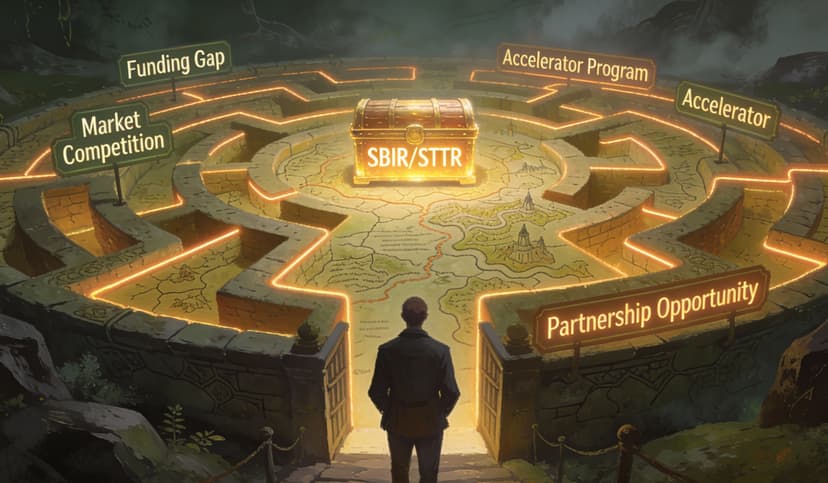
The Lean SBIR/STTR Strategy: How to Secure Funding Without Derailing Your Startup
Feeling overwhelmed? This article presents a streamlined, efficient process for managing an SBIR/STTR application, designed specifically for busy deep tech founders.

How to Reverse-Engineer a Winning DoD SBIR Application in Under an Hour
What if you could decode the formula for a winning $250k+ government grant in the time it takes to watch an episode of Fallout? Everyone talks about DoD SBIR grants like they're some mythical beast -- here's the cheat code.
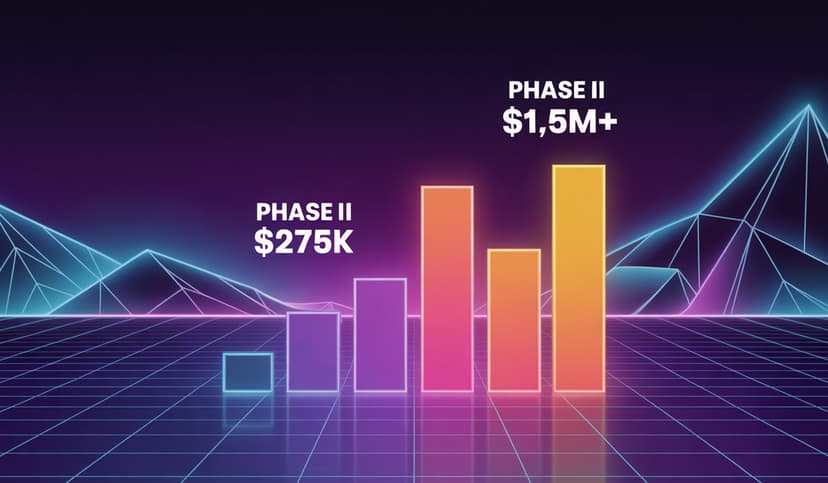
Beyond the First Check: How a Phase I SBIR Unlocks a Funding Roadmap
Most founders glance at a $250,000 SBIR Phase I grant and think, 'Cool. That buys us a few months. Nice, but not a game-changer.' They're missing the whole point.

How to Leverage Your SBIR Phase I Award for Follow-On Funding and VC Investment
You won an SBIR Phase I grant. Pop the champagne. You earned it. But in the epic game of startup funding, you didn't just finish a race -- you found the first Chaos Emerald.

How to Structure an SBIR Proposal That Actually Wins: A Breakdown
Spend five minutes on r/SBIR, and you'll see the same question pop up again and again: 'Can anyone share a winning proposal?' Success rates hover around 15-20%, and 20% of applications are thrown out for simple errors before a reviewer even sees them.